
Automating Governed Lifecycle Intelligence for Regulated Engineering
Regulated engineering organizations have more lifecycle evidence than ever — and less ability to preserve the meaning, authority, lineage, assumptions, and defensibility behind it.
AI can generate insight. Regulation requires defensibility.
Governed Intelligence helps organizations detect interpretive debt, structure fragmented lifecycle evidence, and move from governance exposure to automated defensibility.
Assess. Protocolize. Configure. Automate.
The Structural Gap
AI adoption in regulated industries does not stall because models are weak.
It stalls because governance is missing.
When machine-generated outputs and lifecycle evidence intersect with:
ISO 26262 functional safety obligations;
ISO 21434 cybersecurity requirements
ASPICE process assessments;
UNECE R155/R156 controls;
AS9100 quality management obligations;
DO-178C/DO-254 airworthiness requirements;
supplier contractual commitments;
audit, recall, warranty, and litigation exposure;
organizations face structural questions:
Who is authorized to rely on this output?
Under what conditions is evidence admissible?
What assumptions support the decision?
What regulatory obligations are triggered?
How is accountability preserved?
Has evidence propagated beyond its original authorized context?
What happens if the output is incomplete, outdated, or wrong?
Without governance, AI introduces hesitation instead of acceleration.
Teams manually shadow-review outputs.
Decisions stall.
Audit anxiety increases.
Institutional confidence erodes.
The problem is architectural.
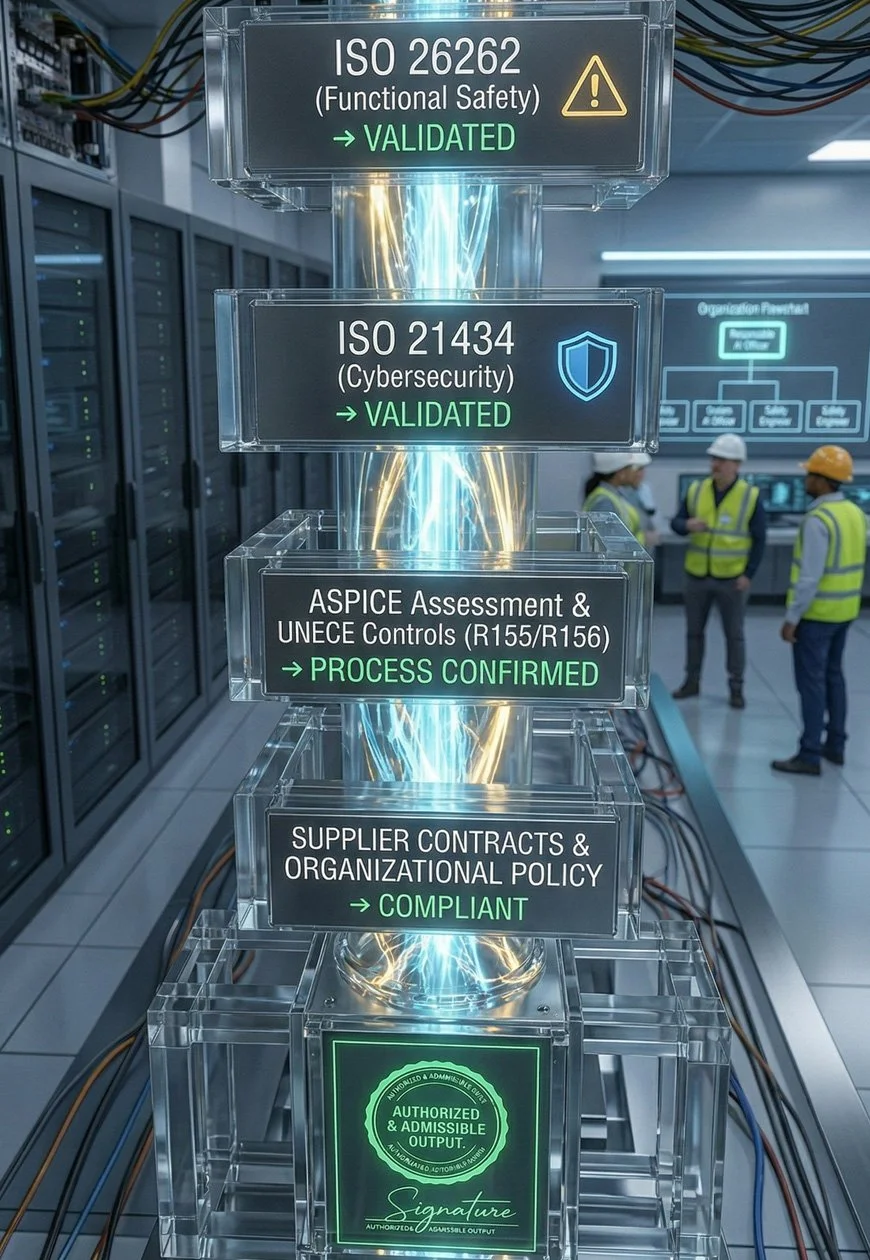
The Governed Intelligence Path
Governed Intelligence provides a staged path from fragmented lifecycle evidence to automated governed intelligence.
Identify where lifecycle evidence is not yet bounded, traceable, reconstructable, or defensible
Our assessments and EGRA readiness diagnostic help organizations understand where interpretive debt may already be accumulating across waivers, assumptions, dependencies, supplier evidence, software releases, and audit records.
Assess
Apply Governed Intelligence protocols to define the rules, relationships, authority boundaries, triggers, review patterns, and reconstruction logic required for defensible governance.
The protocols convert governance risk into structured operating logic.
Protocolize
Map fragmented customer evidence into automation-ready structures.
Protocol Automation Sprints define source-system mappings, evidence relationships, governance triggers, baseline findings, and minimum viable evidence graph requirements.
Configure
Deploy the Automated Governed Intelligence Fabric to monitor governed evidence, detect drift and gaps, prioritize human review, and produce defensible governance readouts.
The goal is not another system of record.
The goal is governed intelligence across systems of record.
Automate
The Governance Control Plane
Analytics engines may evolve, improve, or be replaced.
Governance must remain stable.
The patent-pending Governed Intelligence Framework establishes the architecture required to preserve meaning, authority, lineage, admissibility, and auditability across fragmented lifecycle evidence and machine-generated outputs.
It is designed to operate above and across existing enterprise systems, including:
PLM;
ALM;
QMS;
Cybersecurity systems;
Supplier systems;
Release systems;
Audit and compliance repositories;
Analytics and AI engines.
The Governed Intelligence Framework does not replace these systems.
It governs how evidence, outputs, assumptions, authority, and decisions are interpreted, connected, escalated, and defended.

Initial Markets: Automotive & Aerospace Governance
Automotive and aerospace are the first applied markets for the Governed Intelligence Framework because evidence is fragmented, software releases are accelerating, supplier complexity is increasing, and compliance obligations are rising across both domains.
Software-defined vehicles, OTA updates, cybersecurity requirements, supplier dependencies, and safety-critical release decisions require more than record retention. The same is true of aerospace programs, where airworthiness certification, supplier traceability, and configuration management carry comparable evidentiary stakes.
They require defensible reconstruction.
Governed Intelligence helps automotive and aerospace teams begin with governance assessment, apply structured protocols, and move toward automation of lifecycle defensibility.
Target outcomes include:
Reduced audit preparation friction;
Earlier visibility into traceability gaps;
Improved cross-system evidence visibility;
Clearer waiver, assumption, and dependency governance;
Stronger authority and escalation discipline;
Governance is the platform.
Better preparation for audit, recall, regulatory, supplier, and release-readiness scrutiny.

Why Governed Intelligence
Governed Intelligence is building the automated governance layer for regulated engineering evidence.
Our work focuses on a core institutional challenge: records may exist, but meaning, authority, assumptions, context, and defensibility can fragment over time.
GI Chairman Scott J. McCormick coined the term interpretive debt to describe this accumulated governance liability.
Governed Intelligence helps organizations detect where interpretive debt is forming, structure the evidence required to manage it, and move toward automated governed intelligence.
The problem is architectural.
The solution is the Governed Intelligence Framework.
Leadership
Governed Intelligence is led by practitioners in high-consequence systems, commercialization, governance architecture, and AI/software implementation.
The team combines domain authority, category creation, protocol architecture, commercial execution, and implementation expertise.
Contact Us